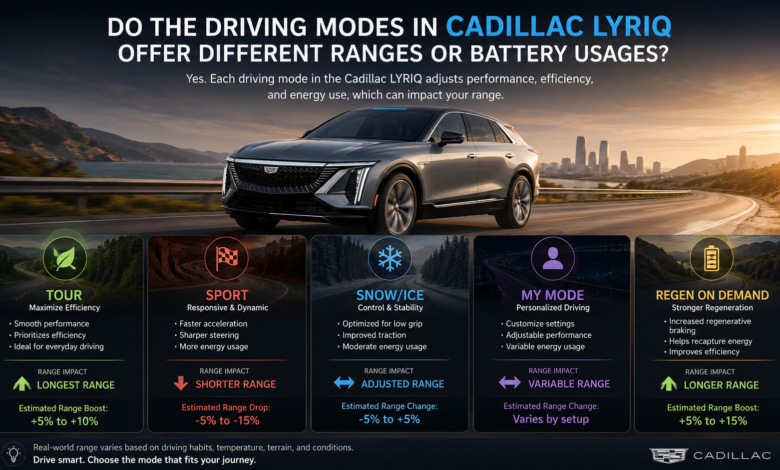
Yes, the Do the Driving Modes in Cadillac LYRIQ Offer Different Ranges or Battery Usages?, but they do not give the battery a different fixed capacity or create separate official EPA range ratings for each mode.
The key distinction is between a drive mode and a driving style. Cadillac’s drive modes can change aspects of how the LYRIQ responds to driver inputs and road conditions. Those changes may encourage smoother or more aggressive driving, which can affect how quickly the vehicle consumes energy. However, selecting a particular mode does not physically add or remove usable battery capacity.
In practical terms, a driver using smooth acceleration and moderate speeds may achieve better efficiency than an aggressive driver, regardless of the selected mode. Sport-oriented settings can contribute to higher energy use if their sharper response encourages rapid acceleration, while a more relaxed setup can make efficient driving easier.
Cadillac also emphasizes regenerative braking as a way to capture energy during deceleration. For the 2025 LYRIQ, Cadillac described its Driver Mode Selector as a way to customize driving preferences or adapt to changing road conditions, while separately highlighting regenerative braking as a feature that can conserve and capture braking energy for added range.
So, do the driving modes in Cadillac LYRIQ offer different ranges or battery usages? Not as fixed, mode-specific range ratings—but the selected mode, driver behavior, regenerative braking use, speed, weather, and road conditions can all affect actual energy consumption and the distance traveled between charges. highstuff
Quick Answer: How Cadillac LYRIQ Drive Modes Affect Range
| Factor | Potential Effect on Battery Usage and Range |
|---|---|
| Tour or normal everyday driving | Generally suited to balanced daily driving |
| Sport-oriented settings | May increase consumption if they encourage stronger acceleration |
| Snow/Ice or traction-focused settings | Designed primarily for control in slippery conditions, not maximum range |
| Personalized settings | Efficiency depends on the chosen configuration and driving behavior |
| Smooth acceleration | Usually helps conserve energy |
| High speeds | Typically increase energy consumption and reduce range |
| Regenerative braking | Can recover energy during deceleration |
| Cold or very hot weather | Can reduce real-world range |
| Heavy HVAC use | Uses battery energy and may reduce available driving range |
The exact modes and available customization can vary by LYRIQ model year and configuration, so owners should check the manual and vehicle settings for their specific vehicle.
How Cadillac LYRIQ Driving Modes Work
The Cadillac LYRIQ is a battery-electric luxury SUV, so its drive modes work differently from traditional gasoline-car modes that may change transmission shift points or engine behavior.
In an EV, drive-mode settings can influence the vehicle’s response and driving characteristics electronically. Depending on the model year and configuration, the LYRIQ’s Driver Mode Selector may provide settings intended for everyday driving, more responsive performance, slippery conditions, or personalized preferences.
The important point is that the drive mode is only one part of the efficiency equation.
The Battery Capacity Does Not Change With the Mode
Switching from one drive mode to another does not give the LYRIQ a larger or smaller battery. The physical energy storage system remains the same.
Instead, the rate at which stored energy is consumed can change because of factors such as:
- Acceleration behavior
- Vehicle speed
- Road conditions
- Traction requirements
- Climate-control use
- Outside temperature
- Elevation changes
- Tire condition and pressure
- Regenerative braking opportunities
This means two drivers starting with the same state of charge can finish identical trips with different remaining battery percentages.
Do the Driving Modes in Cadillac LYRIQ Offer Different Ranges?
Cadillac does not generally present a separate official EPA-estimated range for every selectable driving mode. EPA range figures are standardized vehicle ratings intended to help consumers compare vehicles and configurations.
For example, Cadillac listed the 2025 LYRIQ single-motor rear-wheel-drive model at up to 326 miles of EPA-estimated range and the available dual-motor all-wheel-drive model at up to 319 miles, depending on configuration. These are vehicle/configuration ratings, not separate ratings for Tour, Sport, or other driver-selectable modes.
EPA explains that EV range testing uses standardized laboratory procedures. Official range estimates account for real-world influences through prescribed testing and adjustment methods, but an individual driver’s actual result can still differ because of speed, weather, HVAC use, driving behavior, and other conditions.
Therefore, it would be misleading to say something like:
“Tour mode gives exactly 326 miles, while Sport mode gives exactly 290 miles.”
There is no universal fixed number like that. Actual range varies too much with driving conditions and behavior.
Which Cadillac LYRIQ Driving Mode Uses the Least Battery?
There is no single mode that can guarantee the lowest battery consumption in every situation. WikiPedia
For normal road driving, a balanced mode combined with smooth accelerator inputs is generally the most sensible approach for efficiency. The biggest gains often come from how the vehicle is driven, rather than simply from the name of the mode selected.
The U.S. Department of Energy’s Alternative Fuels Data Center notes that rapid acceleration can reduce EV range compared with gradual acceleration. It also explains that EVs tend to be more efficient in city driving than at highway speeds because frequent deceleration creates more opportunities for regenerative braking, while higher highway speeds require more energy to overcome aerodynamic drag.
Tour or Everyday Driving Settings
A normal or touring-oriented setting is generally appropriate for routine driving. For a driver trying to balance comfort, predictable response, and efficiency, this type of setting is a logical default.
However, Tour mode is not a magic “maximum range” button. A driver traveling at very high speeds or accelerating aggressively can still consume substantial energy while using a normal driving mode.
Sport-Oriented Settings
A sportier configuration may make the vehicle feel more responsive. The mode itself does not automatically drain a predetermined amount of extra battery, but a more responsive setup can make stronger acceleration easier or more tempting.
Rapid acceleration demands more power from the battery. Repeated hard acceleration can therefore increase energy consumption compared with smooth, progressive acceleration.
A driver who selects a sport-oriented mode but maintains a steady speed may see a much smaller efficiency difference than someone who repeatedly uses strong acceleration.
Snow/Ice or Slippery-Condition Settings
A traction-focused mode should primarily be viewed as a control and road-condition feature, not as an efficiency mode.
If roads are covered in snow or ice, actual range may already be affected by several factors unrelated to the drive-mode selection itself. Cold temperatures can affect EV efficiency, cabin heating requires energy, and difficult road conditions may increase energy demand.
Safety and vehicle control should take priority over trying to save a small amount of battery energy in slippery conditions.
Personalized Driving Settings
If the LYRIQ’s available settings allow the driver to customize vehicle responses, battery consumption will depend on the resulting configuration and how the vehicle is driven.
A personalized setup that encourages smooth inputs may support efficient driving. A more aggressive setup combined with frequent hard acceleration may increase consumption.
Why Sportier Driving Can Reduce Cadillac LYRIQ Range
Electric motors can deliver strong torque quickly, which is one reason EVs can feel so responsive. But rapid acceleration requires energy.
Consider two drivers traveling the same 50-mile route.
Driver A accelerates smoothly, maintains a moderate speed, anticipates traffic, and uses regenerative deceleration effectively.
Driver B repeatedly accelerates hard, travels faster, brakes late, and frequently changes speed.
Even if both drivers use the same drive mode, Driver B may consume more battery energy.
This is why it is better to think of the LYRIQ’s range as the result of a complete system:
Vehicle configuration + drive settings + driving behavior + speed + weather + terrain + HVAC use = real-world energy consumption
The selected driving mode can influence part of that equation, but it does not determine the final range by itself.
Regenerative Braking May Matter More Than the Drive Mode
One of the most important efficiency features in an electric vehicle is regenerative braking.
Instead of wasting all of the vehicle’s kinetic energy as heat through conventional friction brakes, an EV can use its electric motor to recover some energy during deceleration and return it to the battery.
Cadillac specifically promotes regenerative braking in the LYRIQ as a way to capture braking energy for added range.
The U.S. Department of Energy reported in 2024 that a typical EV can be approximately 87%–91% efficient after accounting for regenerative braking, depending on the drive cycle. DOE also noted that net regenerative braking recovered about 22% of energy in the referenced EPA combined city/highway drive cycle. Those figures describe typical EV energy flows rather than a guaranteed result for a specific LYRIQ trip.
Can Regenerative Braking Fully Recharge the Battery While Driving?
No. Regenerative braking recovers some energy that would otherwise be lost during deceleration, but it cannot create energy.
Every energy conversion involves losses. Regeneration can improve efficiency, especially in driving with frequent deceleration, but it will not return all the energy previously used to accelerate the vehicle.
Does One-Pedal Driving Improve LYRIQ Range?
One-Pedal Driving can help drivers manage acceleration and deceleration efficiently by allowing substantial slowing when the accelerator is released.
However, it should not be treated as a guaranteed range booster in every situation.
Its effectiveness depends on how it is used. Smooth driving and anticipating traffic can reduce unnecessary acceleration and braking. On the other hand, repeatedly accelerating and then sharply decelerating is generally less efficient than maintaining momentum when conditions safely allow.
The practical goal is not simply to maximize regeneration. It is to avoid wasting energy in the first place and recover energy when slowing is necessary.
What Affects Cadillac LYRIQ Range More Than Drive Mode?
Several factors can have a major influence on real-world range.
1. Highway Speed
Higher speeds generally require more energy because aerodynamic resistance increases significantly as speed rises.
The U.S. Department of Energy notes that EVs are generally more efficient in city driving than highway driving. At higher speeds, more energy is required to overcome aerodynamic drag.
For a long road trip, sustained speed may have a larger impact on range than switching between two drive modes.
2. Rapid Acceleration
Strong acceleration requires more power. Frequent hard launches can increase energy consumption.
Smooth acceleration is one of the simplest ways to improve efficiency without making major changes to the vehicle.
3. Outside Temperature
Extreme temperatures can reduce EV range. Energy may be needed to heat or cool both the cabin and vehicle systems.
The EPA specifically identifies cold weather, accessory use, and high-speed driving as factors that can significantly lower EV range.
4. Cabin Heating and Air Conditioning
Unlike a gasoline vehicle that can use waste engine heat, an EV must manage cabin comfort using electrical energy.
Heavy heating or air-conditioning use can therefore reduce the energy available for driving.
5. Terrain
Driving uphill requires additional energy. Some energy may be recovered through regenerative braking on the descent, but not all of the energy used to climb can be recovered.
6. Tires and Vehicle Load
Tire pressure, tire type, cargo, passengers, and external accessories can influence efficiency. More resistance or weight can increase the energy needed to move the vehicle.
How to Maximize Cadillac LYRIQ Range
If your priority is getting the most practical range from a charge, focus on driving technique and conditions rather than searching for a single “best” mode.
For better efficiency:
- Use a balanced everyday driving mode for normal conditions.
- Accelerate smoothly rather than using maximum power unnecessarily.
- Maintain moderate speeds when practical and safe.
- Anticipate traffic to avoid repeated hard acceleration and braking.
- Learn to use the LYRIQ’s regenerative braking features smoothly.
- Keep tires properly inflated according to Cadillac’s recommendations.
- Reduce unnecessary cargo and external aerodynamic drag.
- Use climate control thoughtfully, especially in extreme temperatures.
- Plan charging stops with a realistic range buffer.
- Monitor the vehicle’s energy-use information to learn which habits improve your own efficiency.
Can the LYRIQ’s Estimated Range Change After Switching Modes?
A vehicle’s displayed range estimate can change as the system updates its prediction based on energy use and operating conditions. However, a change in the displayed estimate should not be interpreted as the drive mode physically changing the battery’s capacity.
EV range displays are estimates, not promises. Actual remaining range can change based on recent driving behavior, speed, weather, terrain, climate-control demand, and other factors.
If a sportier setting leads to more aggressive driving and higher recent energy consumption, the predicted remaining range may decline faster. Conversely, efficient driving may improve the vehicle’s range projection.
Cadillac LYRIQ Range: Drive Mode vs. Vehicle Configuration
It is also important not to confuse drive mode with drivetrain configuration.
A rear-wheel-drive LYRIQ and an all-wheel-drive LYRIQ may have different official EPA range ratings because their hardware configurations differ. That is different from selecting a software-based drive mode inside the same vehicle.
For example, Cadillac’s published 2025 figures listed up to 326 miles of EPA-estimated range for the single-motor RWD LYRIQ and up to 319 miles for available dual-motor AWD versions.
In simple terms:
- RWD vs. AWD: Different vehicle hardware configurations can have different official range ratings.
- Tour vs. Sport or another selectable mode: The same vehicle does not receive a new battery capacity or a separate fixed EPA range every time the driver changes modes.
That distinction answers much of the confusion around Cadillac LYRIQ battery usage.
Practical Takeaway
The best way to understand the effect of drive modes is to monitor your own vehicle’s efficiency over similar routes.
Try driving a familiar route under comparable conditions while paying attention to:
- Energy consumption
- Average speed
- Outside temperature
- HVAC use
- Acceleration habits
- Remaining battery percentage
Do not assume that every difference is caused by the selected drive mode. Traffic, wind, temperature, and speed can significantly change results.
Over time, the vehicle’s energy information can help you identify which driving habits work best for your routine.
Conclusion
So, do the driving modes in Cadillac LYRIQ offer different ranges or battery usages? They can influence real-world energy consumption indirectly by changing vehicle response and how the driver interacts with the car, but they do not provide separate fixed battery capacities or guaranteed range figures for each mode.
A sportier setup may contribute to higher battery usage if it encourages rapid acceleration. A balanced everyday setup combined with smooth driving may be more efficient. Traction-focused modes are intended primarily for appropriate road conditions rather than maximum range.
For most LYRIQ owners, speed, acceleration, temperature, climate-control use, terrain, and regenerative braking habits are likely to matter more than the drive-mode label alone.
If maximum range is your goal, use a mode appropriate for the conditions, drive smoothly, maintain moderate speeds, use regenerative braking intelligently, and monitor your vehicle’s actual energy consumption.
Frequently Asked Questions
1. Does Sport mode reduce the range of a Cadillac LYRIQ?
Sport-oriented settings can contribute to higher energy consumption if they lead to stronger or more frequent acceleration. However, there is no universal fixed number of miles lost simply by selecting Sport mode.
2. Which Cadillac LYRIQ driving mode gives the best range?
There is no single mode that guarantees the best range in every situation. For everyday driving, a balanced setting combined with smooth acceleration, moderate speed, and efficient climate-control use is generally the best approach.
3. Does changing drive modes change the LYRIQ’s battery capacity?
No. Changing a drive mode does not alter the physical capacity of the battery. It can change vehicle behavior, which may affect the rate of energy consumption.
4. Does regenerative braking increase Cadillac LYRIQ range?
Regenerative braking can improve efficiency by recovering some energy during deceleration and returning it to the battery. It cannot recover all energy used while driving, but it can help reduce energy waste.
5. Is the Cadillac LYRIQ more efficient in city or highway driving?
Like many EVs, the LYRIQ can benefit from lower speeds and more regenerative-braking opportunities in city driving. High-speed highway travel generally requires more energy because of increased aerodynamic drag.
6. Why does my Cadillac LYRIQ range estimate change?
Estimated range can vary with recent driving behavior, speed, weather, terrain, HVAC use, battery state of charge, and other operating conditions. The displayed number is a prediction rather than a guaranteed distance.
7. Does cold weather affect the LYRIQ more than the selected drive mode?
It can. Cold temperatures and cabin heating can significantly affect EV energy use. In some situations, weather and HVAC demand may have a greater effect on real-world range than the difference between driving modes.
8. Does AWD use more battery than RWD in the Cadillac LYRIQ?
The two configurations can have different official range ratings because they use different drivetrain hardware. For the 2025 model year, Cadillac published up to 326 miles of EPA-estimated range for the single-motor RWD model and up to 319 miles for available dual-motor AWD models, depending on configuration.
Suggested Internal Links
- Cadillac LYRIQ real-world range explained
- How regenerative braking works in electric vehicles
- Cadillac LYRIQ charging time and charging speeds
- RWD vs. AWD electric vehicles: range and efficiency
- How cold weather affects EV battery range
- Best ways to improve electric vehicle efficiency
Suggested Authoritative External Sources
- Cadillac official LYRIQ vehicle and feature pages — for model-specific features, configurations, and published EPA-estimated range figures.
- Cadillac LYRIQ Owner’s Manual — for exact drive-mode operation and features for a specific model year.
- U.S. Environmental Protection Agency (EPA) — for official explanations of EV range testing and factors affecting real-world range.
- U.S. Department of Energy Alternative Fuels Data Center (AFDC) — for authoritative information on EV efficiency, regenerative braking, speed, and driving conditions.
- FuelEconomy.gov — for official U.S. vehicle efficiency and range comparisons.
Secondary and Semantic Keywords Used
Cadillac LYRIQ driving modes, Cadillac LYRIQ range, Cadillac LYRIQ battery usage, LYRIQ Sport mode range, Cadillac LYRIQ efficiency, EV driving modes, electric vehicle battery consumption, regenerative braking, One-Pedal Driving, Cadillac LYRIQ RWD range, Cadillac LYRIQ AWD range, EV range factors, how to maximize Cadillac LYRIQ range, electric vehicle energy consumption, Cadillac LYRIQ estimated range.
WhiteMoney.co.uk