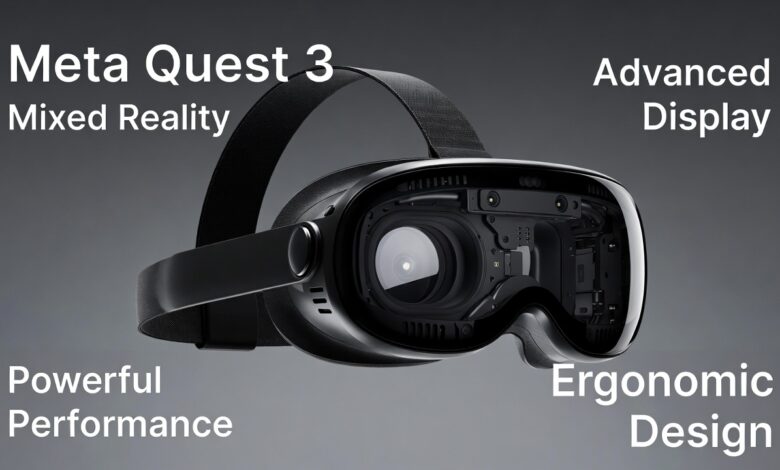
The meta quest 3 represents a decisive leap in standalone virtual reality and mixed reality technology. It stands at the intersection of immersive gaming, spatial computing, and next-generation entertainment. While earlier headsets introduced users to untethered VR, the meta quest 3 refines that vision with stronger hardware, sharper optics, advanced mixed reality capabilities, and a more ergonomic design.
In a rapidly evolving immersive-tech landscape, consumers demand more than novelty. They expect performance, comfort, clarity, and long-term value. The meta quest 3 answers these expectations with remarkable balance. It serves gamers, creators, professionals, and everyday explorers who want to step into digital worlds without complex setups or external sensors.
This in-depth guide explores every aspect of the meta quest 3, including design, hardware architecture, software ecosystem, performance benchmarks, mixed reality innovation, and its broader impact on immersive computing.
What Is Meta Quest 3?
The meta quest 3 is a standalone virtual and mixed reality headset developed by Meta Platforms under its Reality Labs division. It succeeds the widely adopted Meta Quest 2 and introduces a more powerful chipset, redesigned optics, and full-color passthrough technology.
Unlike traditional VR systems that rely on external computers or consoles, the meta quest 3 operates independently. It integrates processing power, tracking systems, sensors, and display hardware directly within the headset. Users can download apps, play immersive games, collaborate in virtual spaces, and interact with digital overlays in real-world environments.
Its defining feature lies in its mixed reality capability. Instead of isolating users entirely in a virtual space, the meta quest 3 blends digital elements with the physical world through advanced passthrough cameras. This innovation transforms how users interact with content, making spatial computing more practical and intuitive.
Detailed Biography Table of Meta Quest 3
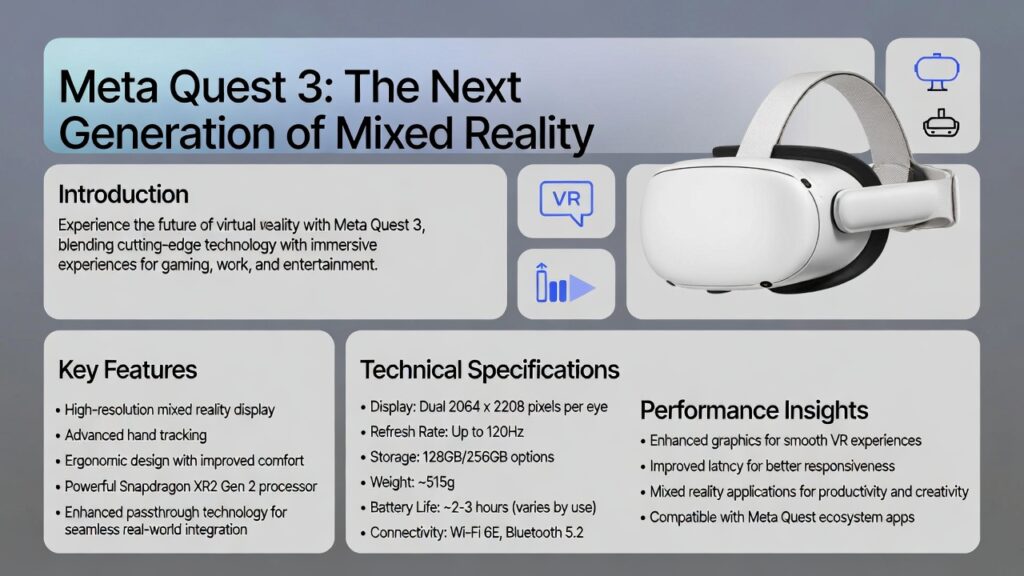
Below is a comprehensive overview that functions as a technical and developmental biography of the meta quest 3:
| Category | Details |
|---|---|
| Product Name | meta quest 3 |
| Developer | Meta Platforms |
| Division | Reality Labs |
| Product Type | Standalone Virtual Reality & Mixed Reality Headset |
| Release Year | 2023 |
| Predecessor | Meta Quest 2 |
| Processor | Qualcomm Snapdragon XR2 Gen 2 |
| Display Type | Dual LCD panels |
| Resolution | 2064 x 2208 pixels per eye |
| Refresh Rates | 90Hz (default), 120Hz (supported) |
| Optics | Pancake lenses |
| Field of View | Approximately 110° horizontal |
| Tracking System | Inside-out tracking with multiple cameras |
| Mixed Reality | Full-color high-resolution passthrough |
| Controllers | Touch Plus Controllers |
| Storage Options | 128GB / 512GB |
| Connectivity | Wi-Fi 6E, Bluetooth |
| Audio | Integrated spatial speakers |
| Primary Use Cases | Gaming, Fitness, Education, Collaboration, Media |
| Platform Ecosystem | Quest Store & Horizon ecosystem |
| Weight | Lighter and slimmer than predecessor |
| Strap System | Adjustable soft strap (Elite Strap optional) |
This table encapsulates the technical DNA and strategic positioning of the meta quest 3, reflecting its role as a performance-oriented and future-ready immersive device.
Design and Build: Precision Meets Comfort
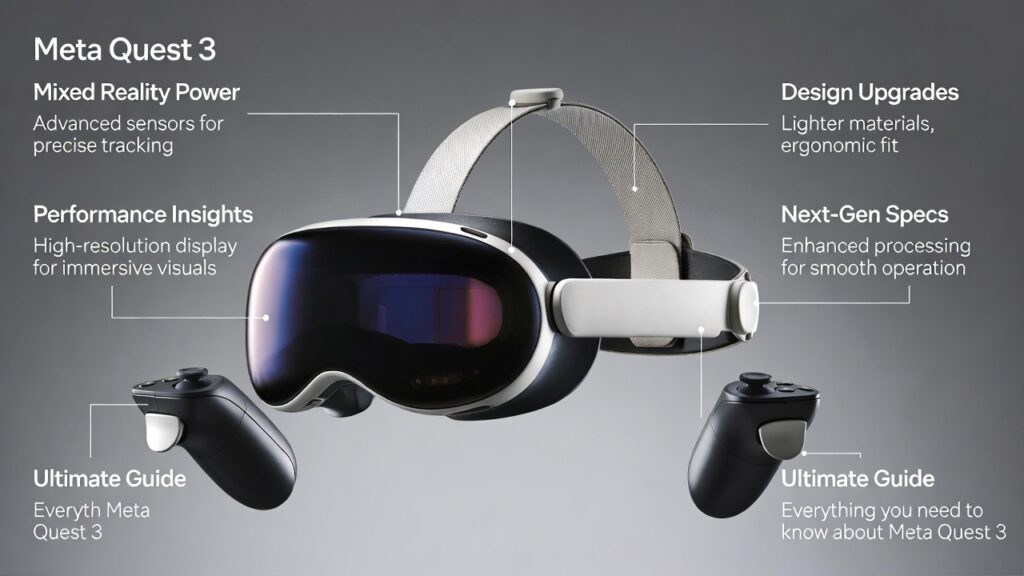
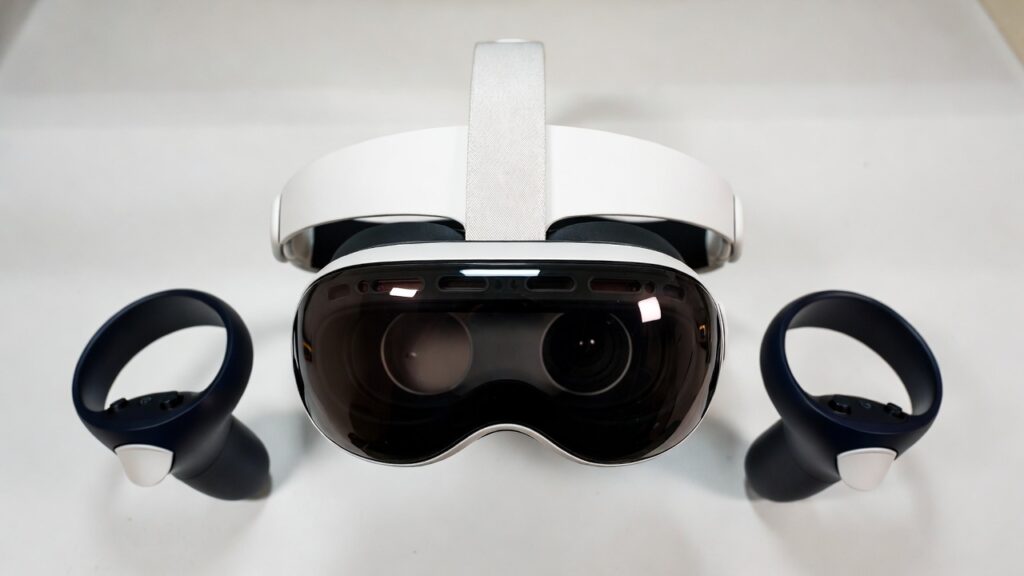
The meta quest 3 features a noticeably slimmer profile than its predecessor. Engineers achieved this reduction through pancake lens technology, which shortens the optical stack without sacrificing clarity. The result feels lighter and more balanced on the face.
The front housing integrates multiple sensors and full-color cameras seamlessly into a curved, minimalist shell. The improved weight distribution reduces strain during extended sessions. Adjustable straps ensure comfort for diverse head shapes, while optional accessories enhance fit and stability.
The controllers also received refinement. The Touch Plus controllers eliminate the large tracking rings seen in earlier designs. They rely on advanced internal tracking systems, allowing more natural hand movement and improved durability.
Display and Optics: Sharper, Brighter, More Immersive
Visual fidelity defines immersive realism. The meta quest 3 improves resolution significantly over previous models, delivering 2064 x 2208 pixels per eye. Text appears crisper. Fine environmental details emerge with clarity. Motion remains fluid at 90Hz, with support for 120Hz in compatible applications.
Pancake lenses enhance edge-to-edge clarity while minimizing distortion. Users experience reduced glare and improved contrast. This optical refinement enhances gaming realism, cinematic playback, and productivity tasks.
The expanded field of view further deepens immersion. Peripheral vision captures more of the environment, which strengthens presence and realism during interactive sessions.
Performance Power: Snapdragon XR2 Gen 2
The meta quest 3 integrates Qualcomm’s Snapdragon XR2 Gen 2 processor, purpose-built for spatial computing. This chipset doubles graphical performance compared to its predecessor, enabling more detailed environments and complex physics simulations.
Developers can design richer worlds without sacrificing performance stability. Advanced lighting, dynamic shadows, and more responsive interactions now operate smoothly within a standalone framework.
The headset also includes enhanced memory and faster bandwidth, ensuring multitasking capability. Users can switch between immersive games, productivity tools, and media applications without noticeable lag.
Mixed Reality Innovation
One of the most transformative features of the meta quest 3 lies in its full-color passthrough cameras. These cameras project the real world into the headset with improved clarity and depth perception.
Instead of existing purely in virtual isolation, users can overlay digital objects onto physical surroundings. Imagine placing a virtual chessboard on your kitchen table or expanding a productivity workspace across your living room walls. The meta quest 3 makes these interactions intuitive and responsive.
Advanced depth sensors enhance spatial mapping accuracy. The headset understands room geometry in real time. This capability supports interactive mixed reality games, collaborative design tools, and immersive educational simulations.
Gaming Ecosystem and Content Library
The meta quest 3 benefits from an established ecosystem built by Meta Platforms. The Quest Store offers hundreds of VR titles across genres such as action, simulation, rhythm, horror, sports, and narrative adventure.
Existing titles optimized for earlier Quest models often receive graphical enhancements when running on the meta quest 3. Improved textures, higher frame rates, and more complex visual effects enhance gameplay quality.
Major franchise titles and exclusive VR experiences continue expanding the library. Fitness-focused games, multiplayer social platforms, and immersive storytelling projects reinforce the headset’s long-term value.
Productivity and Professional Use Cases
Beyond gaming, the meta quest 3 supports practical productivity workflows. Virtual workspaces allow users to position multiple floating screens in a three-dimensional layout. Remote collaboration becomes more engaging through spatial avatars and shared digital environments.
Mixed reality capabilities enable architects, educators, and designers to visualize models directly within physical environments. A 3D building model can appear inside an office conference room. Educational diagrams can hover above a classroom desk.
This blending of digital and physical interaction suggests a future where spatial computing enhances everyday work.
Audio Experience and Spatial Sound
The integrated spatial audio system in the meta quest 3 delivers immersive directional sound without external headphones. Speakers positioned within the headset project audio naturally around the user.
Sound cues shift according to head movement. Footsteps approach from behind. Environmental ambience surrounds the listener. This audio depth strengthens immersion and heightens realism during both gaming and cinematic experiences.
Users who prefer private listening can connect headphones via supported audio options.
Connectivity and Wireless Freedom
The meta quest 3 supports Wi-Fi 6E, ensuring faster data transfer and lower latency. Wireless PC streaming allows users to access more demanding VR titles through compatible setups while maintaining cable-free movement.
Bluetooth connectivity supports accessories such as keyboards and headphones. The headset integrates seamlessly with modern wireless ecosystems, ensuring convenience and flexibility.
Comparing Meta Quest 3 to Meta Quest 2
The meta quest 3 improves upon the foundation established by the Meta Quest 2 in nearly every measurable dimension.
It delivers sharper resolution, significantly stronger processing power, slimmer design, improved controllers, and advanced mixed reality capabilities. While the earlier model introduced millions to standalone VR, the meta quest 3 expands that experience with professional-grade refinement.
Users upgrading from Quest 2 notice clearer visuals, faster performance, and transformative passthrough functionality.
Battery Life and Practical Usage
Battery life typically ranges between two to three hours, depending on application intensity. High-performance mixed reality applications and graphically demanding games reduce runtime slightly.
Optional accessories such as extended battery straps can increase usage time. Most users find the default battery sufficient for immersive sessions without excessive interruption.
Long-Term Value and Market Position
The meta quest 3 occupies a strategic position in the evolving spatial computing market. It balances affordability with advanced capabilities. It targets both mainstream consumers and early adopters seeking premium performance.
Its improvements reflect broader industry trends toward mixed reality integration and spatial interaction. As immersive software evolves, the meta quest 3 stands prepared to support increasingly complex applications.
Is Meta Quest 3 Worth It?
The answer depends on user expectations. Gamers seeking high-resolution standalone VR will find the meta quest 3 highly compelling. Professionals exploring spatial workflows gain access to mixed reality tools that extend beyond entertainment.
The combination of performance, portability, clarity, and ecosystem support establishes strong value. It represents not merely a hardware upgrade but a shift toward practical spatial computing.
Deduction: A Refined Vision of Immersive Technology
The meta quest 3 advances virtual and mixed reality into a more polished and powerful phase. It integrates cutting-edge optics, enhanced performance, full-color passthrough, and ergonomic design into a cohesive platform.
Its blend of entertainment, productivity, and mixed reality innovation positions it as a cornerstone of modern immersive technology. Users who invest in the meta quest 3 do not simply purchase a headset. They enter a spatial ecosystem designed to evolve with future software and creative possibilities.
As immersive computing continues expanding, the meta quest 3 stands as a confident step toward a more interactive digital future.