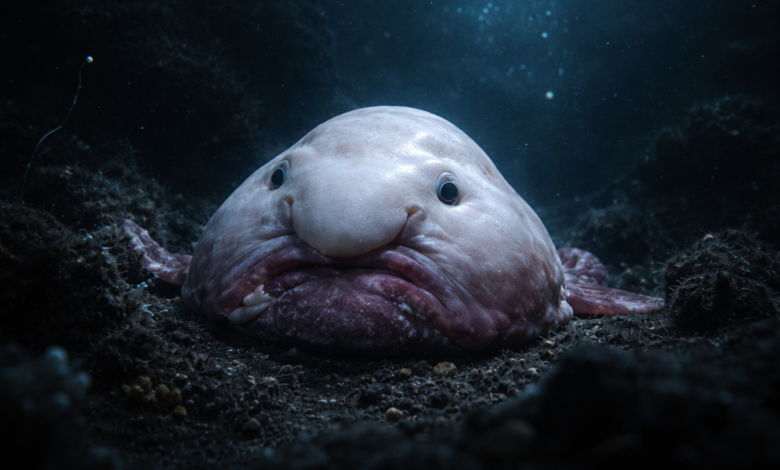
The ocean hides countless mysteries, but few creatures have captured public imagination quite like the blobfish. Often labeled as the “world’s ugliest animal,” this deep-sea species suffers from a reputation built on misunderstanding rather than scientific truth. While images of its droopy, gelatinous face circulate widely online, they rarely represent how the blobfish truly exists in its natural habitat.
This article explores the fascinating biology, ecological role, and scientific significance of the blobfish, presenting a deeper and more accurate perspective. By the end, it becomes clear that this creature is not a symbol of ugliness but a remarkable example of evolutionary adaptation.
Biography Table of the blobfish
| Attribute | Details |
|---|---|
| Common Name | Blobfish |
| Scientific Name | Psychrolutes marcidus |
| Family | Psychrolutidae |
| Habitat | Deep waters off Australia, Tasmania, and New Zealand |
| Depth Range | 600–1,200 meters |
| Diet | Crustaceans, sea urchins, mollusks |
| Lifespan | Estimated several decades |
| Reproduction | Egg-laying with parental guarding |
| Conservation Status | Vulnerable (due to deep-sea trawling) |
| Distinct Feature | Gelatinous body adapted to high pressure |
Understanding the Natural Habitat of the blobfish
The blobfish thrives in one of the most extreme environments on Earth—the deep sea. At depths exceeding 600 meters, sunlight disappears completely, temperatures drop dramatically, and pressure increases to levels that would crush most surface-dwelling organisms.
In such conditions, survival requires highly specialized adaptations. The blobfish lives along the ocean floor, where food is scarce and movement must be energy-efficient. Unlike active predators, it conserves energy by drifting slightly above the seabed, waiting for edible material to pass within reach.
This environment shapes every aspect of the blobfish’s biology, from its structure to its behavior.
The Unique Anatomy of the blobfish
The most striking feature of the blobfish is its unusual appearance—particularly when removed from its natural environment. However, this appearance is misleading.
Adaptation to Pressure
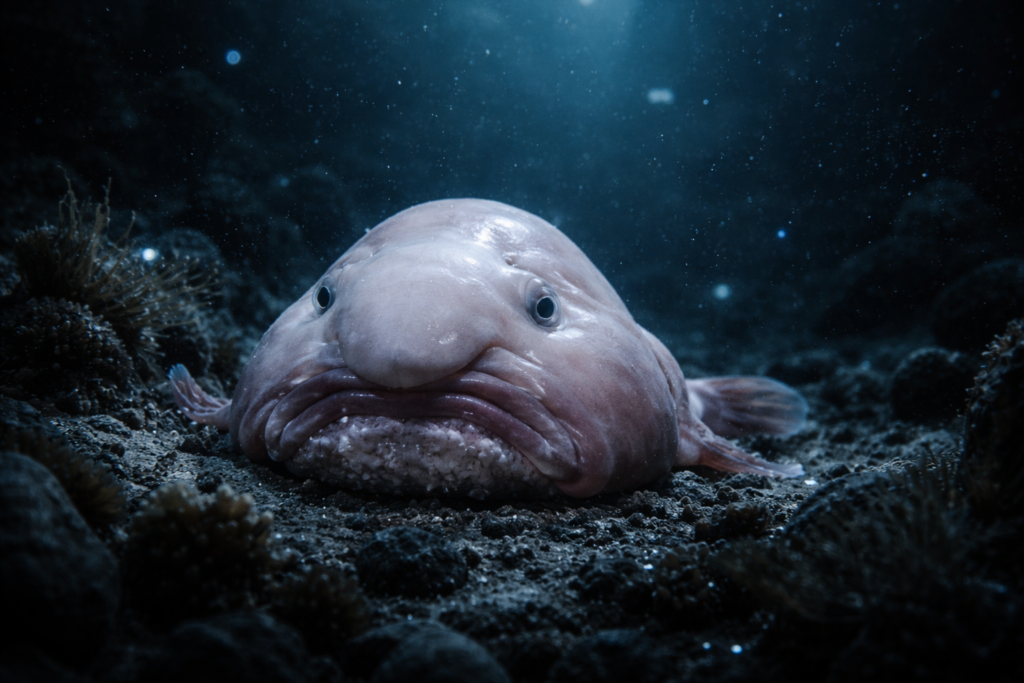
Under deep-sea pressure, the body of the blobfish appears relatively normal. Its gelatinous flesh becomes structured and stable due to the immense surrounding force. This allows the fish to maintain its shape without a rigid skeleton or swim bladder.
Gelatinous Composition
Unlike most fish, the blobfish lacks dense muscle tissue. Instead, its body consists of a gelatinous mass slightly less dense than water. This enables it to float just above the ocean floor without expending energy on swimming.
Facial Features Explained
The drooping face associated with the blobfish is a result of rapid decompression when it is brought to the surface. Without high-pressure support, its tissues collapse, creating the iconic “melting” look that has become widely recognized.
Feeding Behavior of the blobfish
The blobfish is not an active hunter. Instead, it adopts a passive feeding strategy that suits its environment.
It consumes:
- Small crustaceans
- Mollusks
- Sea urchins
- Organic debris drifting through the water
By opening its mouth and waiting, the blobfish allows food to come to it. This method minimizes energy use, which is crucial in a habitat where food is limited and unpredictable.
Reproductive Habits of the blobfish
The reproductive behavior of the blobfish reveals another fascinating aspect of its biology.
Female blobfish lay thousands of eggs in clusters on the ocean floor. What sets them apart is their dedication to guarding these eggs. They remain close, protecting them from predators and ensuring their development in a hostile environment.
This parental investment increases the chances of survival for the offspring, a critical advantage in deep-sea ecosystems where life is fragile.
Why the blobfish Looks So Different Outside Water
The global perception of the blobfish largely stems from images taken after it has been removed from deep water.
Pressure Loss Effects
At the surface, the pressure drops drastically. The gelatinous body of the blobfish, which relies on high pressure for structure, loses its form. This results in:
- Sagging skin
- Distorted facial features
- A “blobby” appearance
Misrepresentation in Media
Photographs of decompressed blobfish have circulated widely, creating an unfair representation. In reality, the creature appears far more typical in its natural state, with features adapted perfectly to its environment.
The Ecological Role of the blobfish
Despite its unusual reputation, the blobfish plays an important role in deep-sea ecosystems.
Maintaining Balance
By feeding on small invertebrates, the blobfish helps regulate populations of bottom-dwelling organisms. This contributes to ecological stability in the deep ocean.
Part of the Food Web
Although not a dominant predator, the blobfish occupies a vital position within the food chain. It both consumes and is consumed, linking various levels of marine life.
Threats Facing the blobfish
The blobfish faces several threats, most of which stem from human activity.
Deep-Sea Trawling
Commercial fishing operations often use bottom trawling methods that drag large nets across the ocean floor. These nets unintentionally capture blobfish along with targeted species.
Because the blobfish lives at great depths, it cannot survive rapid ascent to the surface, making bycatch particularly devastating.
Habitat Disruption
Trawling not only captures organisms but also damages the seafloor habitat. This disrupts ecosystems and reduces the availability of food and shelter for the blobfish.
Limited Scientific Data
The remote nature of its habitat means that scientists still lack comprehensive data about population size and trends. This makes conservation efforts more challenging.
Conservation Efforts and Awareness
Although the blobfish is not widely studied compared to other marine species, awareness is growing.
Public Attention
Ironically, the unusual appearance of the blobfish has helped draw attention to deep-sea conservation issues. Increased awareness can lead to stronger protections.
Sustainable Fishing Practices
Efforts to regulate deep-sea fishing and reduce bycatch can significantly benefit the blobfish and similar species.
Scientific Research
Advancements in deep-sea exploration technology allow researchers to study the blobfish in its natural environment without harming it. This contributes to better understanding and protection strategies.
Cultural Impact of the blobfish
The blobfish has become a cultural phenomenon, often used as a symbol of unattractiveness or humor. However, this representation oversimplifies its biological reality.
In truth, the blobfish represents resilience and adaptation. Its ability to survive in extreme conditions highlights the diversity and ingenuity of life on Earth.
Scientific Importance of the blobfish
From a scientific perspective, the blobfish offers valuable insights into deep-sea biology.
Evolutionary Adaptation
Studying the blobfish helps scientists understand how organisms evolve to survive under extreme pressure, low temperature, and limited resources.
Material Science Inspiration
The gelatinous structure of the blobfish may inspire new materials designed to withstand high-pressure environments, with applications in engineering and exploration.
Debunking Myths About the blobfish
Several misconceptions surround the blobfish, many of which deserve clarification.
Myth 1: It Is Naturally Ugly
The blobfish appears normal in its natural habitat. Its “ugly” appearance results from decompression.
Myth 2: It Is Lazy
Its passive feeding strategy is an efficient survival mechanism, not a sign of inactivity.
Myth 3: It Has No Purpose
Every species, including the blobfish, plays a role in maintaining ecological balance.
The Future of the blobfish
The future of the blobfish depends largely on human actions. With improved conservation measures and sustainable fishing practices, its population can remain stable.
Continued research will also deepen our understanding of this species and its environment. Protecting the blobfish ultimately contributes to preserving the broader deep-sea ecosystem.
Rethinking the blobfish
The blobfish stands as a powerful reminder that appearances can be deceiving. Far from being an oddity, it is a highly specialized organism perfectly adapted to one of the harshest environments on Earth.
Its story encourages a shift in perspective—from ridicule to respect. By appreciating the science behind the blobfish, we gain not only knowledge but also a deeper appreciation for the complexity of life beneath the ocean’s surface.
In a world where many species face growing threats, understanding creatures like the blobfish becomes essential. They are not just curiosities; they are vital components of Earth’s intricate and interconnected ecosystems.